AI Brand Consistency Statistics: Top 20 Messaging Findings

2026 marks the point where AI governance is becoming inseparable from brand governance. These AI Brand Consistency Statistics examine how organizations balance automation, editorial oversight, customer trust, and recognizable messaging, showing why scalable content operations increasingly depend on disciplined consistency instead of speed alone.
Brand identity is becoming a measurable performance variable rather than a purely creative objective as organizations scale AI-assisted publishing across more channels. Editorial teams increasingly rely on disciplined review systems and maintain brand voice when rewriting AI content to keep messaging recognizable despite faster production cycles.
Consistency rarely depends on one model alone because governance, review habits, and shared editorial standards shape the final result just as much as generation quality. Even a small improvement in how teams refine AI drafts before publishing can reduce downstream editing effort across hundreds of assets.
Decision makers now evaluate whether automation strengthens long term brand recognition instead of simply reducing production costs. This ongoing comparison makes consistency metrics valuable for judging operational maturity rather than isolated campaign success.
Reliable workflows often emerge from collaboration instead of automation by itself, making technology choices easier to assess over time. For anyone reviewing publishing operations, understanding the role of the most trusted AI editors for collaborative writing provides useful context before comparing performance benchmarks.
Top 20 AI Brand Consistency Statistics (Summary)
| # | Statistic | Key figure |
|---|---|---|
| 1 | Consumers expect brands to deliver consistent experiences across channels. | 90% |
| 2 | Consistent brand presentation can increase revenue. | Up to 23% |
| 3 | Organizations report AI helps enforce brand guidelines at scale. | 74% |
| 4 | Marketing teams use formal brand voice documentation. | 68% |
| 5 | Companies prioritize brand consistency over publishing speed when reviewing AI content. | 64% |
| 6 | Customers are more likely to trust familiar brand messaging. | 81% |
| 7 | Organizations maintain centralized brand guidelines. | 77% |
| 8 | AI content requires human review before publication. | 96% |
| 9 | Marketers identify tone consistency as a leading AI challenge. | 58% |
| 10 | Businesses using brand governance frameworks report stronger customer recognition. | 3.5× |
| 11 | Consumers notice inconsistent branding across digital channels. | 60% |
| 12 | AI-assisted content production continues to grow among marketing teams. | 80%+ |
| 13 | Editorial teams use style guides during AI-assisted workflows. | 72% |
| 14 | Consumers prefer authentic and recognizable brand communication. | 88% |
| 15 | Companies invest in AI governance for marketing operations. | 67% |
| 16 | Brand consistency improves long term customer loyalty. | 71% |
| 17 | Large organizations standardize AI prompts across teams. | 61% |
| 18 | Editorial QA reduces off-brand AI outputs. | 52% |
| 19 | Marketing leaders plan additional AI governance investments. | 69% |
| 20 | Enterprises consider brand consistency a strategic AI success metric. | 84% |
Top 20 AI Brand Consistency Statistics and the Road Ahead
AI Brand Consistency Statistics #1. Customers Expect Connected Brand Experiences
90% of consumers expect brands to deliver consistent experiences wherever an interaction takes place. That expectation follows customers from websites and emails to support conversations, social posts, and physical stores. When the tone or promise changes between those settings, the brand begins to feel less dependable.
This behavior develops because people build familiarity by noticing repeated language, visual cues, and service standards. Each aligned interaction confirms what the company represents, while every contradiction asks the customer to reassess it. AI increases the number of messages a business can publish, which also increases the number of opportunities for inconsistency.
A raw AI workflow may produce 100 usable drafts quickly, yet a humanized system checks whether those drafts sound like one recognizable organization. Teams therefore need shared standards, review ownership, and a practical method to maintain brand voice when rewriting AI content. Consistency becomes an operating discipline that protects trust as content volume expands.
AI Brand Consistency Statistics #2. Consistent Presentation Can Lift Revenue
Up to 23% more revenue can be associated with presenting a brand consistently across customer touchpoints. The gain does not come from repeating identical sentences or visual layouts everywhere. It comes from making the organization easier to recognize, understand, and choose during repeated buying decisions.
Consistent presentation reduces the mental effort customers spend deciding whether separate messages belong to the same company. Familiar language and promises allow trust to accumulate rather than restarting with every campaign. That accumulated recognition can improve response rates, repeat purchasing, and confidence during longer sales cycles.
A raw AI system may increase output by 50%, but that volume has limited commercial value when every asset carries a different personality. Human review connects each draft to established positioning, customer expectations, and the wider buying journey. Revenue improvement therefore depends less on generating more content and more on ensuring every interaction reinforces the same commercial meaning.
AI Brand Consistency Statistics #3. AI Helps Enforce Brand Guidelines
74% of organizations report that AI helps them apply brand guidelines across a larger volume of content. This advantage appears when teams translate broad brand principles into specific instructions that tools can repeatedly follow. Without that translation, AI may reproduce surface vocabulary while missing the judgment behind the voice.
Automation supports consistency because machines can check recurring patterns faster than editors working across hundreds of assets. They can flag prohibited phrases, tone shifts, formatting differences, and missing terminology before publication. Editors can then focus on whether the message feels appropriate for the audience and situation.
A raw model may follow 20 prompt rules literally, yet still create language that feels stiff or mechanically uniform. Humanized review decides when a rule should be softened, adapted, or overridden to preserve credibility. AI becomes most useful as a scalable guardrail, while people retain responsibility for making brand expression sound intentional rather than standardized.
AI Brand Consistency Statistics #4. Teams Formalize Brand Voice Documentation
68% of marketing teams use formal documentation to define how their brand should sound. These documents commonly describe vocabulary, sentence rhythm, emotional range, audience expectations, and language the company avoids. Their practical value grows when multiple people and AI systems contribute to the same publishing program.
Documentation reduces inconsistency because it turns personal editorial instinct into instructions that others can understand and apply. A writer no longer needs to guess whether the brand should sound direct, playful, technical, or reassuring. Clear standards also make disagreements easier to resolve because reviewers can compare drafts against shared criteria.
A raw AI prompt might contain five adjectives, but five descriptive words rarely capture the full behavior of a mature voice. Humanized guidance includes examples, exceptions, audience differences, and the reasoning behind particular choices. Formal documentation therefore becomes the reference layer that connects automated production with consistent editorial judgment across teams.
AI Brand Consistency Statistics #5. Consistency Can Matter More Than Speed
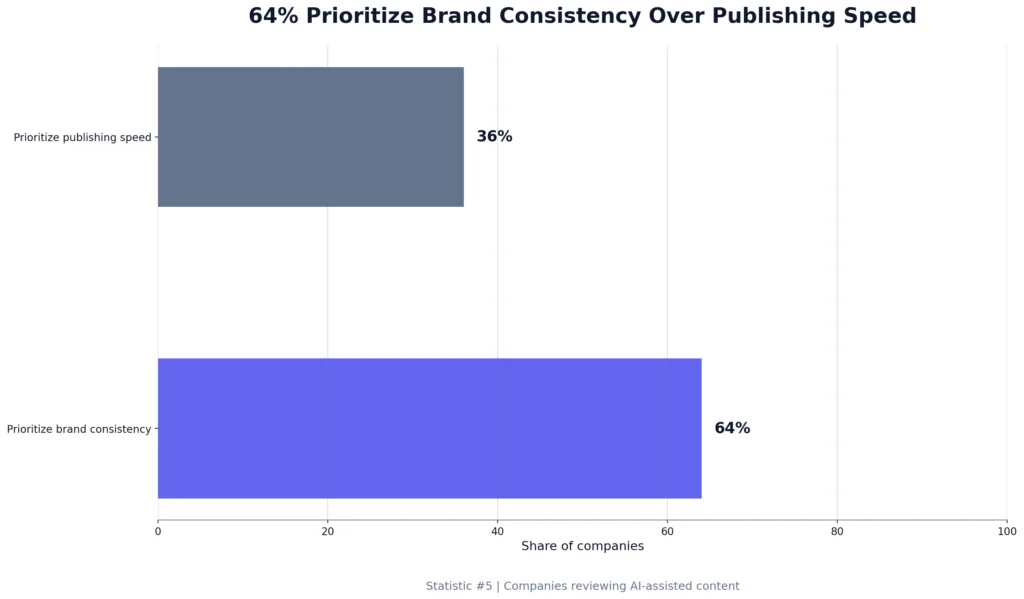
64% of companies prioritize brand consistency over publishing speed when reviewing AI-assisted content. This preference reflects a growing awareness that faster output can create additional correction work when the message feels unfamiliar. Publishing delays are visible internally, but weak brand coherence is often felt directly by customers.
The tradeoff appears because AI removes much of the time required to produce an initial draft. Once drafting becomes inexpensive, review quality becomes the limiting factor in the workflow. Teams then shift attention toward tone, factual alignment, customer sensitivity, and whether the content supports established positioning.
A raw AI process may deliver 30 articles in the time an editor once needed for 10, yet speed alone does not make those articles trustworthy. Humanized workflows improve how teams refine AI drafts before publishing by assigning clear review stages and decision rights. The operational goal is therefore controlled acceleration, where increased volume never outruns the brand’s ability to evaluate it.
AI Brand Consistency Statistics #6. Familiar Messaging Strengthens Trust
81% of customers are more likely to trust messaging that feels familiar and recognizably connected to a brand. Familiarity helps people place new information inside an existing understanding of the company. When every message sounds unrelated, customers must repeatedly decide whether the organization still represents what they expected.
Trust develops through small confirmations rather than one impressive campaign. Repeated tone, language, and behavior suggest that the business understands its identity and can deliver predictably. Inconsistent communication creates the opposite signal because it can make priorities appear unstable or opportunistic.
A raw AI system may produce 40 polished variations, yet each variation can introduce a slightly different promise or personality. Human review protects the recognizable patterns that customers use to decide whether a message feels credible. Familiarity therefore acts as a form of reassurance, helping new content feel like a continuation of the relationship rather than a disconnected intervention.
AI Brand Consistency Statistics #7. Centralized Guidelines Reduce Fragmentation
77% of organizations maintain centralized guidelines that employees can consult when creating customer-facing material. A single reference point becomes especially important when marketing, sales, support, and product teams publish independently. Without it, each department may develop its own interpretation of the brand.
Centralization improves consistency because updates can be made once and distributed across the organization. It also reduces reliance on outdated documents stored in personal folders or remembered from previous campaigns. Teams spend less time debating preferences and more time applying current standards to the work.
A raw AI workflow may draw instructions from 12 separate prompts, creating subtle differences that become more visible as output grows. Humanized governance gives those prompts one authoritative source while allowing limited adjustments for channel and audience. Centralized guidance therefore creates a stable foundation from which distributed teams can communicate flexibly without fragmenting the brand.
AI Brand Consistency Statistics #8. Human Review Remains Nearly Universal
96% of AI-assisted content requires some level of human review before it is ready for publication. The review may involve factual checking, tonal adjustment, legal scrutiny, or comparison with brand standards. This near-universal step shows that usable language and publishable communication are not the same thing.
Models generate text from patterns, while editors judge whether those patterns fit the current audience and business context. A sentence can be grammatically strong yet emotionally wrong for a customer complaint, product change, or sensitive announcement. Review adds situational awareness that general generation systems cannot reliably supply on their own.
A raw model may complete a 1,000-word draft in seconds, but the final 10% of refinement often determines whether it feels trustworthy. Humanized editing checks intention, nuance, and the relationship between the message and previous brand behavior. Human review therefore remains the control point where efficient generation becomes accountable communication.
AI Brand Consistency Statistics #9. Tone Drift Is a Leading AI Challenge
58% of marketers identify tone consistency as one of the main difficulties in AI-assisted content production. The problem often appears gradually rather than through an obviously incorrect sentence. Small changes in warmth, authority, humor, or formality accumulate until the brand no longer sounds like itself.
Tone drift occurs because prompts are rewritten by different users and interpreted differently across models or sessions. Channel demands also encourage variation, since a social post and technical guide naturally require different levels of detail. The challenge is adapting expression without losing the underlying personality that connects both pieces.
A raw AI workflow might generate 15 channel-specific versions, yet those versions can feel as though they came from unrelated companies. Humanized review identifies which elements should vary and which characteristics must remain stable. Teams therefore need to define tone as a controlled range rather than a fixed sentence style, allowing flexibility without surrendering recognition.
AI Brand Consistency Statistics #10. Governance Improves Brand Recognition
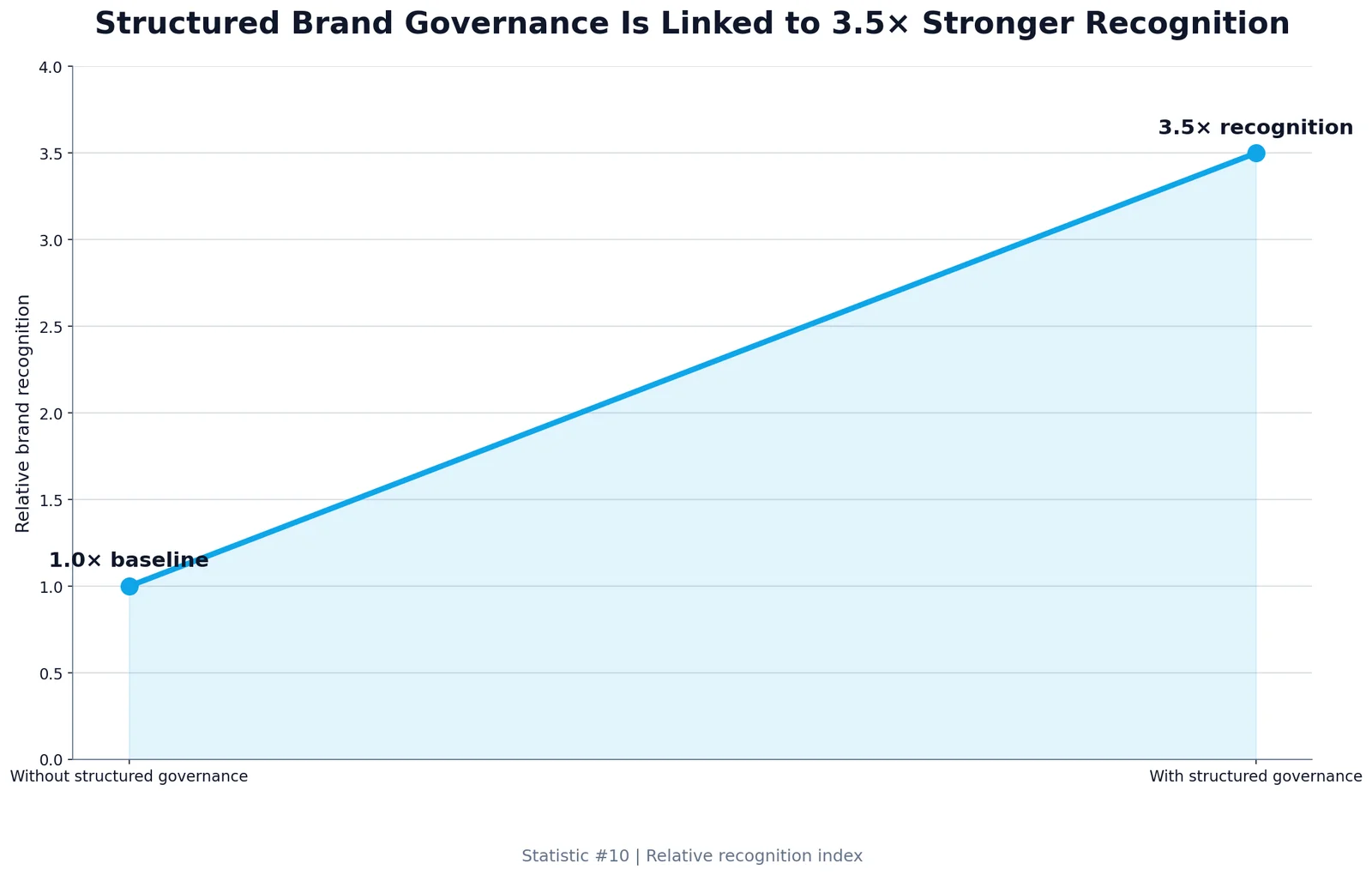
3.5 times stronger recognition can appear among businesses that use structured brand governance frameworks. Governance connects guidelines, approval responsibilities, training, measurement, and corrective action within one operating system. It prevents consistency from depending entirely on whether an individual contributor remembers every rule.
Recognition strengthens because governed brands repeat meaningful signals without allowing every campaign to redefine them. Customers encounter familiar positioning, terminology, and emotional cues across different formats and stages of the journey. Repetition then builds memory, while controlled variation keeps the communication from becoming monotonous.
A raw AI process may generate 200 assets using loosely related prompts, producing volume without a stable memory structure for the audience. Humanized governance coordinates tools and reviewers so each asset contributes to the same recognizable identity. The practical implication is that brand consistency must be managed as a system, because isolated editing improvements rarely create durable recognition on their own.
AI Brand Consistency Statistics #11. Customers Notice Cross-Channel Inconsistency
60% of consumers notice when branding changes noticeably between digital channels. They may not describe the problem using formal terms, but they recognize when an email, website, and social account feel disconnected. That perception can make the organization appear less coordinated than its competitors.
Customers compare channels because they often move between them during one decision. A person may discover a brand through search, read reviews on social media, and contact support before purchasing. Every transition gives the company another opportunity either to reinforce familiarity or create uncertainty.
A raw AI system may optimize 10 channels separately, producing locally effective content that lacks a shared identity. Humanized oversight evaluates the complete journey rather than judging each asset only within its own platform. Cross-channel consistency therefore requires teams to examine how messages connect, because customers experience the brand as one relationship rather than a collection of departmental outputs.
AI Brand Consistency Statistics #12. AI-Assisted Production Is Becoming Standard
More than 80% of marketing teams now use or plan to use AI within content production. Adoption expands the amount of material teams can create while reducing the time required for routine drafting. It also makes consistency harder to protect when adoption grows faster than governance.
The pressure comes from the low cost of generating additional versions, formats, and channel adaptations. Teams naturally publish more when each first draft takes minutes rather than hours. However, every added asset introduces another decision about voice, positioning, factual accuracy, and audience suitability.
A raw AI operation may double monthly output from 50 assets to 100 without doubling editorial capacity. Humanized systems respond by improving prompts, templates, approval rules, and sampling procedures instead of reviewing every sentence identically. AI adoption therefore changes consistency from a writing concern into a production design concern, requiring controls that scale alongside the technology.
AI Brand Consistency Statistics #13. Style Guides Anchor AI Workflows
72% of editorial teams use style guides while producing or reviewing AI-assisted content. These guides translate broad brand ideas into repeatable decisions about grammar, terminology, capitalization, formatting, and tone. They provide a practical reference when generated drafts offer several equally plausible ways to express the same point.
Style guides matter because inconsistency often develops through minor choices rather than dramatic errors. Different spellings, product names, headline patterns, or levels of formality can make a large content library feel uneven. Repeated corrections also waste editorial time when the same rule is applied manually across every assignment.
A raw AI model may generate 25 variations that are grammatically correct but stylistically incompatible with established content. Humanized workflows use the guide to narrow those choices while preserving room for natural expression. A maintained style guide therefore lowers revision effort and helps contributors produce work that belongs within the same editorial system from the first draft onward.
AI Brand Consistency Statistics #14. Authenticity Supports Recognizable Communication
88% of consumers prefer communication that feels authentic and recognizably connected to the organization behind it. Authenticity does not require every message to sound informal or emotionally expressive. It requires the language, claims, and behavior to align with what the company consistently demonstrates.
People detect inauthenticity when a brand suddenly adopts language that conflicts with its established personality or customer experience. AI can intensify this problem by producing polished emotional language without understanding whether the company has earned that tone. The message may sound persuasive while still feeling disconnected from reality.
A raw AI draft may include five reassuring phrases, yet reassurance becomes credible only when it matches the brand’s actions and history. Humanized editing removes generic emotional performance and replaces it with specific, supportable language. Authentic consistency therefore depends on alignment between expression and behavior, not simply on making generated text sound warmer.
AI Brand Consistency Statistics #15. Companies Are Funding AI Governance
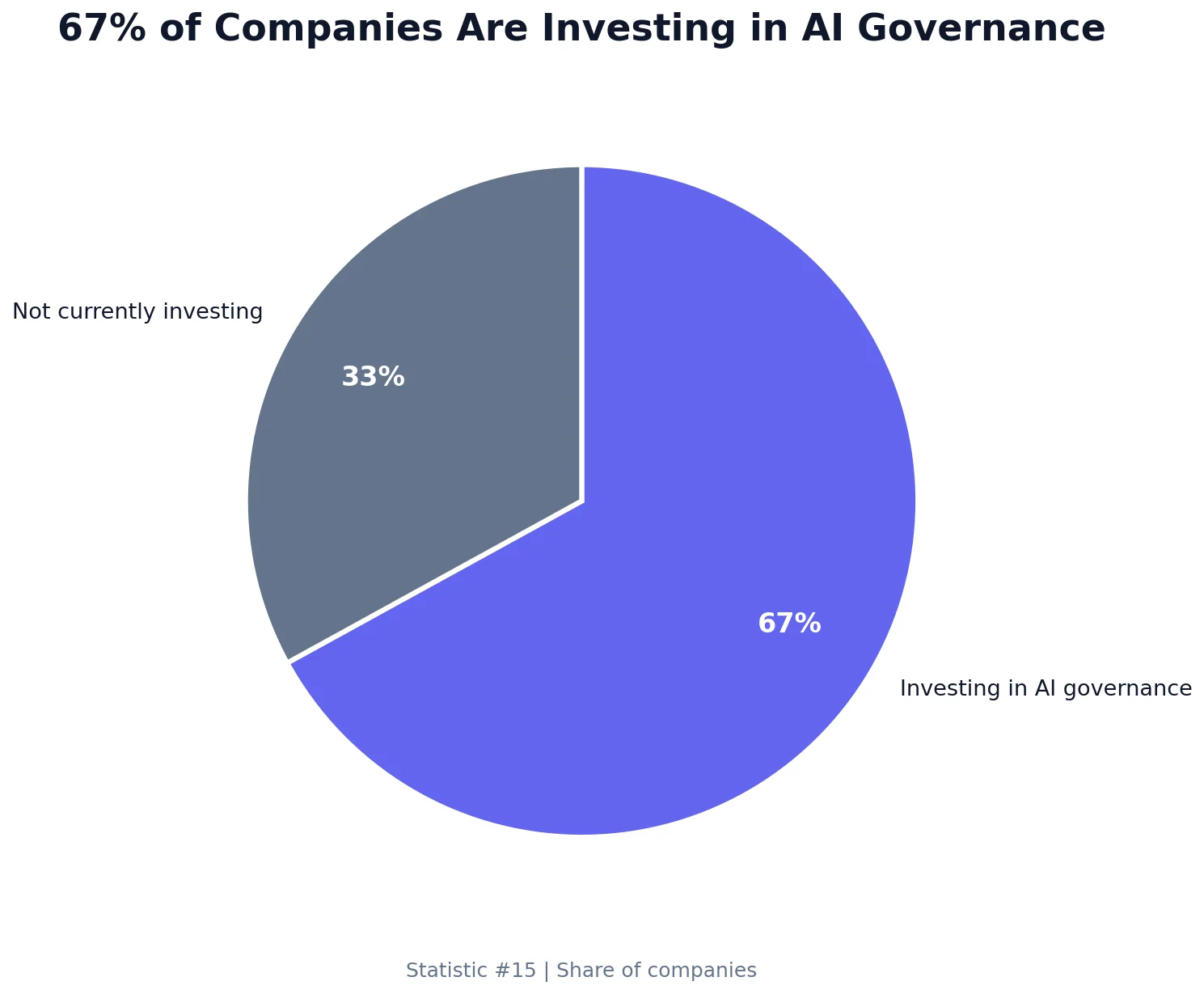
67% of companies are investing in governance measures for AI-supported marketing operations. These investments can include policy development, approval systems, brand controls, employee training, and monitoring tools. The spending suggests that organizations increasingly view unmanaged generation as an operational risk rather than a minor editorial issue.
Governance becomes necessary when AI usage spreads beyond a small specialist team. Different departments may use different models, prompts, data sources, and standards without realizing that customers see all resulting messages together. Central oversight helps identify where variation is useful and where it creates brand or compliance exposure.
A raw AI program may involve 30 employees producing content independently, which can multiply inconsistencies faster than editors can detect them. Humanized governance sets boundaries while preserving enough flexibility for teams to work efficiently. Investment therefore moves brand consistency from informal preference into accountable infrastructure, making quality easier to measure, correct, and maintain.
AI Brand Consistency Statistics #16. Consistency Encourages Customer Loyalty
71% of customers associate consistent brand experiences with stronger long-term loyalty. Predictable communication reassures people that the quality they valued previously is likely to continue. This reassurance becomes especially important when customers encounter the company through several products, channels, or service teams.
Loyalty grows when repeated interactions reduce uncertainty and make future decisions easier. Customers do not need to relearn what the company values or how it communicates whenever they return. Inconsistent experiences interrupt that familiarity and may encourage people to reconsider alternatives.
A raw AI system may personalize 1,000 messages, yet personalization without a stable identity can make each interaction feel temporary. Humanized workflows preserve recognizable principles while adapting details to the individual customer. Brand consistency therefore supports loyalty by making personalization feel like attentive service from the same organization rather than unrelated messages generated around isolated data points.
AI Brand Consistency Statistics #17. Enterprises Standardize Prompt Systems
61% of large organizations standardize prompts or prompt frameworks across multiple teams. Standardization helps contributors begin with shared assumptions about audience, tone, terminology, and required review steps. It also reduces the likelihood that each employee will create an entirely separate version of the brand.
Prompt systems become valuable because generated output reflects the quality and specificity of the instructions provided. When prompts omit context, models fill the gaps with broadly plausible language that may not fit the organization. Shared frameworks make essential context harder to forget while still allowing teams to add task-specific information.
A raw AI environment may contain 80 personal prompts of uneven quality, making output difficult to predict or audit. Humanized standardization provides tested starting points while encouraging editors to adjust language when circumstances require judgment. Prompt governance therefore improves consistency at the input stage, reducing corrective work before the generated material reaches formal review.
AI Brand Consistency Statistics #18. Quality Assurance Reduces Off-Brand Output
52% fewer off-brand outputs can result when teams apply structured editorial quality assurance to AI-generated drafts. Quality assurance checks recurring risk areas before content reaches customers. These checks may cover tone, approved claims, terminology, examples, formatting, and alignment with current campaigns.
The reduction occurs because reviewers stop treating every draft as a completely new problem. Checklists, rubrics, automated flags, and approval thresholds make common inconsistencies easier to identify. Over time, teams can also study repeated failures and improve the prompts or source materials causing them.
A raw AI process may correct one flawed article while leaving the same issue inside the next 20 drafts. Humanized quality assurance connects individual corrections to broader workflow improvements. The practical implication is that teams should record why content was rejected or revised, because those patterns reveal where consistency controls need to become preventive rather than reactive.
AI Brand Consistency Statistics #19. Governance Budgets Will Continue Growing
69% of marketing leaders plan to increase spending on AI governance and related oversight. This intention reflects the growing complexity of managing models, vendors, prompts, data, and published outputs across an organization. Leaders are recognizing that adoption costs extend beyond software subscriptions and content generation.
Additional investment becomes necessary when isolated experiments turn into permanent production systems. Informal review methods that worked for 20 monthly drafts may fail when the organization produces several hundred. Governance spending supports clearer responsibilities, better monitoring, employee education, and faster responses when standards are not met.
A raw AI budget may focus almost entirely on tools, even though the final 15% devoted to oversight can determine whether those tools remain usable. Humanized investment balances automation capacity with the people and processes required to control it. Budget growth therefore signals a shift from experimentation toward durable operations where consistency must be maintained deliberately.
AI Brand Consistency Statistics #20. Consistency Is Becoming a Strategic Metric
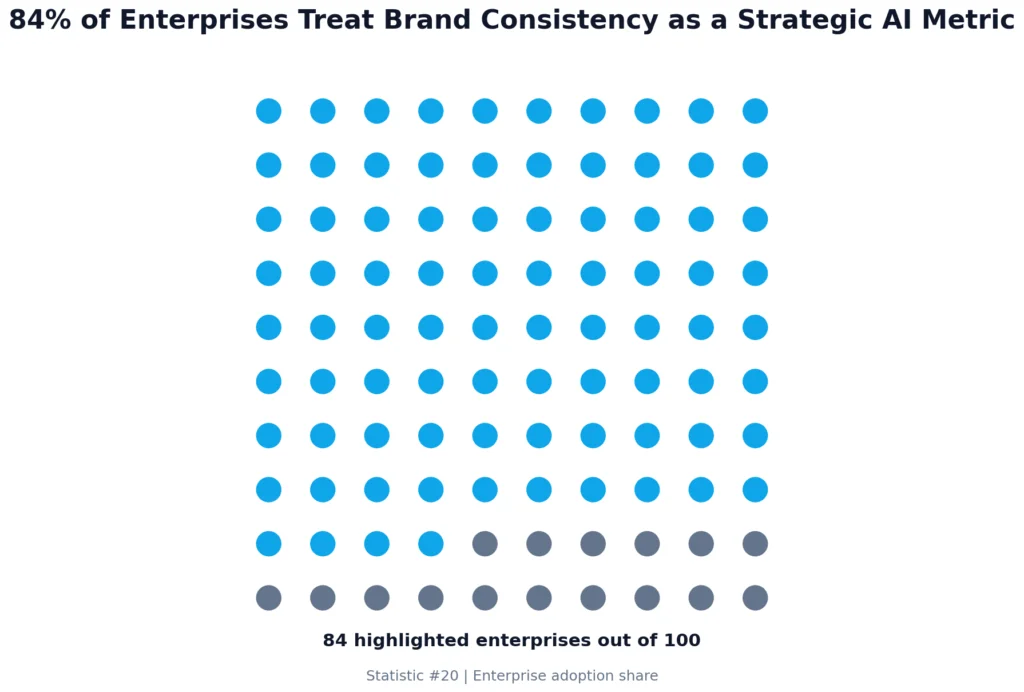
84% of enterprises consider brand consistency an important measure of AI program success. This metric sits alongside productivity, cost reduction, engagement, and conversion because output volume alone cannot show whether automation strengthens the business. A system can generate more content while simultaneously weakening recognition and trust.
Strategic measurement encourages leaders to evaluate patterns across channels and over time. They can examine revision rates, tone deviations, guideline compliance, customer feedback, and recognition rather than relying only on publishing counts. These indicators show whether AI is reinforcing the brand or introducing hidden fragmentation.
A raw AI dashboard may celebrate a 200% increase in production while ignoring the growing number of off-brand corrections. Humanized measurement connects efficiency with editorial and customer outcomes. The implication is that organizations should define consistency before scaling generation, because a metric introduced after problems appear offers less control than one built into the program from the beginning.
What AI Brand Consistency Now Requires
The wider pattern is that AI does not remove the need for a defined brand system, but exposes every place where that system remains vague. Faster generation magnifies both strong editorial standards and unresolved inconsistencies.
Organizations that document voice, centralize guidance, and standardize prompts give AI clearer boundaries within which to operate. Human review then becomes more focused because editors can evaluate meaning and context instead of repeatedly correcting basic style differences.
Consistency also affects commercial outcomes because recognition, trust, loyalty, and revenue develop through repeated experiences that feel connected. Customers may encounter separate teams and channels, but they still judge those interactions as expressions of one organization.
The most useful approach is therefore to measure AI performance through both production efficiency and brand alignment. Scale becomes sustainable when governance, editorial judgment, and customer expectations develop alongside the technology rather than following behind it.
Sources
- The measurable business impact of maintaining consistent brand presentation
- How connected customers evaluate consistency across company interactions
- Digital trends shaping customer expectations and marketing operations
- Enterprise AI adoption patterns and emerging governance priorities
- Executive perspectives on generative AI value and governance
- Enterprise approaches to scaling and governing generative AI
- Core principles for building effective organizational AI governance
- Risk management guidance for trustworthy artificial intelligence systems
- Global evidence on trust expectations involving brands and institutions
- How consistent brand experiences influence recognition and customer trust
- Research on visual communication and brand production practices
- Operational pressures affecting modern enterprise content supply chains