How to Maintain Human Voice in AI-Assisted Writing: 15 Authenticity Safeguards

AI-assisted writing can save time, but preserving your natural rhythm, judgment and perspective requires deliberate editing. The peer-reviewed study found that AI-supported stories became more alike, reinforcing the need to protect distinctive language, examples, and emotional nuance in every draft.
How to Maintain Human Voice in AI-Assisted Writing: 15 Authenticity Safeguards
AI can help you write faster, but speed often comes with a subtle cost that is easy to overlook. Many drafts end up sounding polished yet strangely interchangeable, which is why learning make AI writing read like it was written by a person has become an essential editing skill.
The challenge usually is not that AI produces poor writing, but that it naturally gravitates toward predictable wording, balanced sentence patterns, and generic transitions. Using the right AI refinement platforms for AI-generated drafts can help identify these patterns before they become part of your finished work.
Maintaining a recognizable voice requires deliberate decisions throughout the drafting and editing process rather than a final polish at the end. This guide explains 15 practical safeguards that help preserve personality, credibility, and consistency while drawing on insights from AI draft review statistics to support a more thoughtful workflow.
| # | Strategy focus | Practical takeaway |
|---|---|---|
| 1 | Define your signature style | Start every project with a clear sense of your natural tone before generating or revising content. |
| 2 | Lead with personal intent | Make sure every section reflects your perspective instead of relying on generic explanations. |
| 3 | Vary sentence rhythm | Create more natural pacing by mixing short, medium, and longer sentences throughout the draft. |
| 4 | Replace predictable wording | Swap repetitive expressions for language that better matches your everyday communication style. |
| 5 | Keep real examples | Ground ideas with authentic experiences that add credibility and individuality. |
| 6 | Edit in multiple passes | Separate structural revisions from voice refinement to catch different kinds of issues. |
| 7 | Read content aloud | Use your own voice to uncover awkward phrasing and unnatural transitions before publishing. |
| 8 | Protect emotional nuance | Preserve subtle feelings and emphasis instead of allowing the draft to become overly neutral. |
| 9 | Challenge generic conclusions | Finish sections with original insights rather than formulaic summaries. |
| 10 | Maintain consistent personality | Review the entire piece to ensure the same voice carries from beginning to end. |
| 11 | Question AI suggestions | Treat generated edits as options to evaluate instead of instructions to accept automatically. |
| 12 | Respect audience expectations | Adjust style thoughtfully while keeping your recognizable identity intact. |
| 13 | Preserve intentional imperfections | Leave natural variation where it improves authenticity instead of polishing everything flat. |
| 14 | Build a review checklist | Use repeatable quality checks to maintain consistency across different writing projects. |
| 15 | Refine through repetition | Strengthen your editorial process over time by reviewing patterns across completed work. |
15 Authenticity Safeguards to Maintain Human Voice in AI-Assisted Writing
How to Maintain Human Voice in AI-Assisted Writing – Strategy #1: Define Your Voice
Before asking an AI system to draft or revise anything, describe the qualities that make your writing recognizable, including your usual level of formality, sentence rhythm, humor, directness, and preferred way of explaining difficult ideas. This step matters because a vague request for natural writing gives the model little guidance beyond broad patterns gathered from other texts. Good execution looks like a short voice profile built from specific observations rather than flattering labels such as engaging, professional, or authentic.
A practical voice profile might explain that you use longer sentences when adding nuance, avoid exaggerated claims, and prefer concrete examples over abstract summaries, which gives the system clearer boundaries to follow. This works because the model can imitate visible language choices more reliably than an undefined personality. However, the profile should remain flexible enough to accommodate different formats, since a client email, personal essay, product guide, and technical explanation should not sound identical even when they come from the same writer.
How to Maintain Human Voice in AI-Assisted Writing – Strategy #2: Lead With Intent
Begin each assignment by deciding what you genuinely want the reader to understand, feel, question, or do, then state that intention before generating any copy. Without this direction, AI tends to produce a competent overview that covers familiar points while missing the personal judgment that gives writing a clear reason to exist. Strong execution means defining the central claim in your own words, identifying what you believe matters most, and clarifying which predictable angle you do not want the draft to repeat.
This approach works particularly well when many articles already address the same subject, because your intention becomes the filter that determines which details deserve space and which explanations can be removed. For example, a guide about workplace burnout could focus on workload design rather than generic self-care, allowing the final piece to reflect a more specific perspective. The main constraint is that intent should guide the argument without forcing every paragraph toward a predetermined conclusion that ignores useful evidence or legitimate complexity.
How to Maintain Human Voice in AI-Assisted Writing – Strategy #3: Vary Sentence Rhythm
Review the draft for repeated sentence lengths, symmetrical structures, and evenly paced paragraphs, then introduce more variation where the writing begins to sound mechanically balanced. Human writers naturally shift rhythm as they explain, emphasize, qualify, or pause, while AI often settles into predictable patterns that remain grammatically clean but emotionally flat. Effective revision involves combining related ideas when nuance is needed, shortening only where emphasis deserves it, and allowing occasional irregularity when it supports the natural movement of the thought.
This works because readers respond not only to meaning but also to cadence, and subtle shifts in pace make the writer’s reasoning feel more present on the page. In a reflective section, for instance, a longer sentence can carry several connected observations before a firmer statement gives the reader a moment of clarity. The risk is creating variation for its own sake, since excessive fragments, dramatic pauses, or deliberately tangled sentences can feel just as artificial as perfectly uniform prose.
How to Maintain Human Voice in AI-Assisted Writing – Strategy #4: Replace Generic Language
Search for phrases that could appear unchanged in thousands of unrelated articles, particularly broad transitions, inflated adjectives, empty reassurances, and familiar conclusions that sound polished without adding meaning. These expressions often survive because they are grammatically correct and easy to overlook during a fast review, yet they gradually erase the writer’s individual presence. A stronger approach is to replace them with language tied to the specific situation, the reader’s actual problem, or the judgment you are trying to communicate.
For example, instead of saying that a method can significantly improve results, explain that it reduces the number of revisions needed before a draft is ready for review, because that wording gives the claim a practical shape. This works by moving the sentence away from abstract approval and toward observable value. Still, not every common phrase needs replacing, since familiar wording can improve clarity when it expresses the idea accurately and does not dominate the surrounding prose.
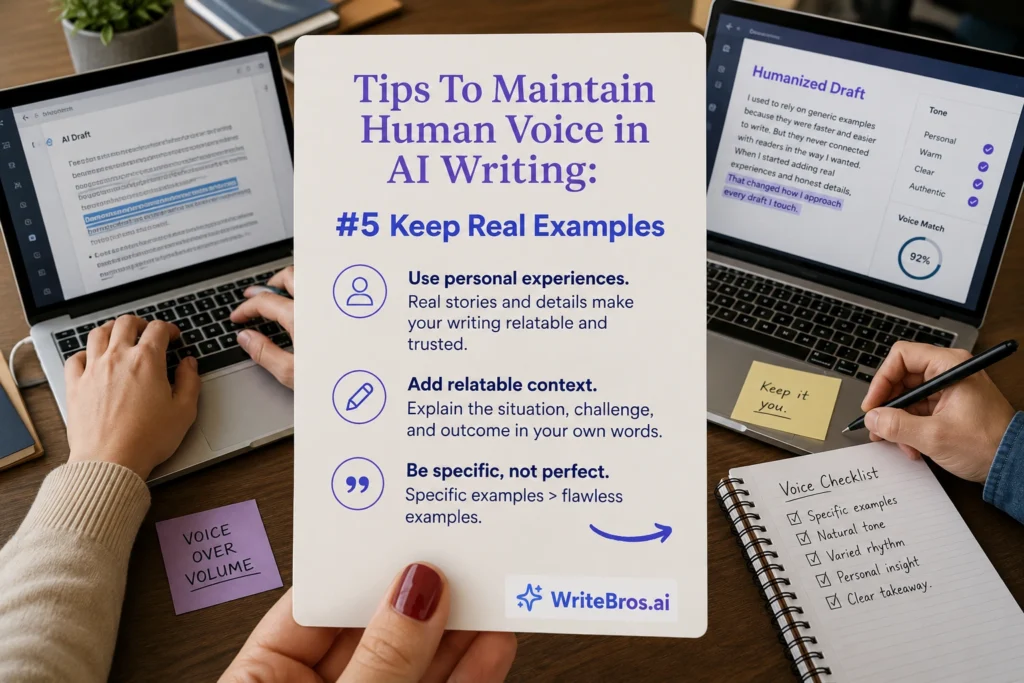
How to Maintain Human Voice in AI-Assisted Writing – Strategy #5: Keep Real Examples
Add examples drawn from actual work, lived experience, repeated observations, or realistic situations that you understand well enough to describe with useful detail. AI can invent plausible scenarios, but those examples often feel overly convenient because every element supports the lesson without the friction, uncertainty, or compromise found in real decisions. Good examples include enough context to show why a choice made sense at the time, what limitation shaped it, and what happened after the decision was applied.
This safeguard works because specific experience introduces details that generic generation cannot easily reproduce, such as an awkward tradeoff, an unexpected reaction, or a result that was useful without being perfect. A writer discussing editing might describe cutting a polished opening because it delayed the actual point, even though the paragraph sounded impressive in isolation. The main caution is privacy, since authentic examples should be anonymized or adjusted when they involve clients, colleagues, confidential information, or circumstances that could identify someone unnecessarily.
How to Maintain Human Voice in AI-Assisted Writing – Strategy #6: Edit in Passes
Separate your review into distinct passes for argument, structure, clarity, voice, and final accuracy rather than trying to repair every weakness during one continuous read. When these tasks are combined, writers often concentrate on obvious grammar improvements while overlooking the broader patterns that make the piece sound generic. A focused voice pass should examine whether the language reflects your normal judgment, whether the transitions feel natural, and whether the emotional temperature remains appropriate from one section to the next.
This process works because each pass gives your attention a narrower purpose, making subtle problems easier to detect without competing with structural decisions or factual checks. For instance, you might first move a key explanation earlier, then later revise its wording so it sounds like something you would naturally say to a reader. The limitation is time, so shorter pieces may need only two combined passes, provided that voice is still reviewed separately from surface-level proofreading.
How to Maintain Human Voice in AI-Assisted Writing – Strategy #7: Read It Aloud
Read the completed draft aloud at a steady conversational pace, paying attention to places where your breathing, emphasis, or natural phrasing begins to resist the sentence on the page. Written language can look smooth while still sounding unnatural, especially when AI has produced overly formal transitions, crowded clauses, or repetitive sentence openings. Good execution means listening for whether the draft resembles your spoken reasoning without assuming that every written sentence must sound casual or conversational.
This method works because your ear often notices stiffness that your eyes have already normalized after several rounds of editing. A sentence may contain accurate information yet feel uncomfortable when spoken, revealing that the clause order, word choice, or transition does not match how you naturally build an explanation. The caveat is that some professional formats require denser language, so the goal is not effortless speech but readable cadence that still respects the purpose and expectations of the document.
How to Maintain Human Voice in AI-Assisted Writing – Strategy #8: Protect Emotional Nuance
Review whether the draft preserves the emotional distinctions you intended, particularly when the subject involves uncertainty, frustration, caution, empathy, or disagreement. AI frequently smooths these differences into a neutral professional tone, which can make a sensitive passage feel distant or cause a critical point to sound more approving than intended. Strong revision restores the right degree of warmth, firmness, hesitation, or concern without turning the writing into exaggerated emotional performance.
This matters in real situations because readers often interpret tone as evidence of judgment, especially when the writer is discussing risk, responsibility, or another person’s experience. A client update, for example, may need to acknowledge a setback honestly while still communicating that the work remains manageable and the next steps are clear. The constraint is proportionality, since too much emotional language can distract from the substance, while too little can make the writer seem indifferent or evasive.
How to Maintain Human Voice in AI-Assisted Writing – Strategy #9: Rewrite Conclusions
Examine the final sentence of every major section, because AI-generated drafts often end with broad summaries, generic encouragement, or statements that simply repeat the paragraph in slightly different words. These endings feel complete on the surface, yet they rarely carry the writer’s perspective forward or prepare the reader for what comes next. A better conclusion should sharpen the implication, reveal a useful tension, or connect the section’s lesson to the larger purpose of the piece.
This works because section endings influence how readers interpret what they have just read, and a thoughtful final line can turn information into a clear editorial judgment. After discussing content review, for example, you might conclude that accuracy protects credibility while voice protects recognition, which adds meaning rather than merely restating the process. The main caution is avoiding a clever line that sounds impressive but introduces a new claim the section has not actually supported.
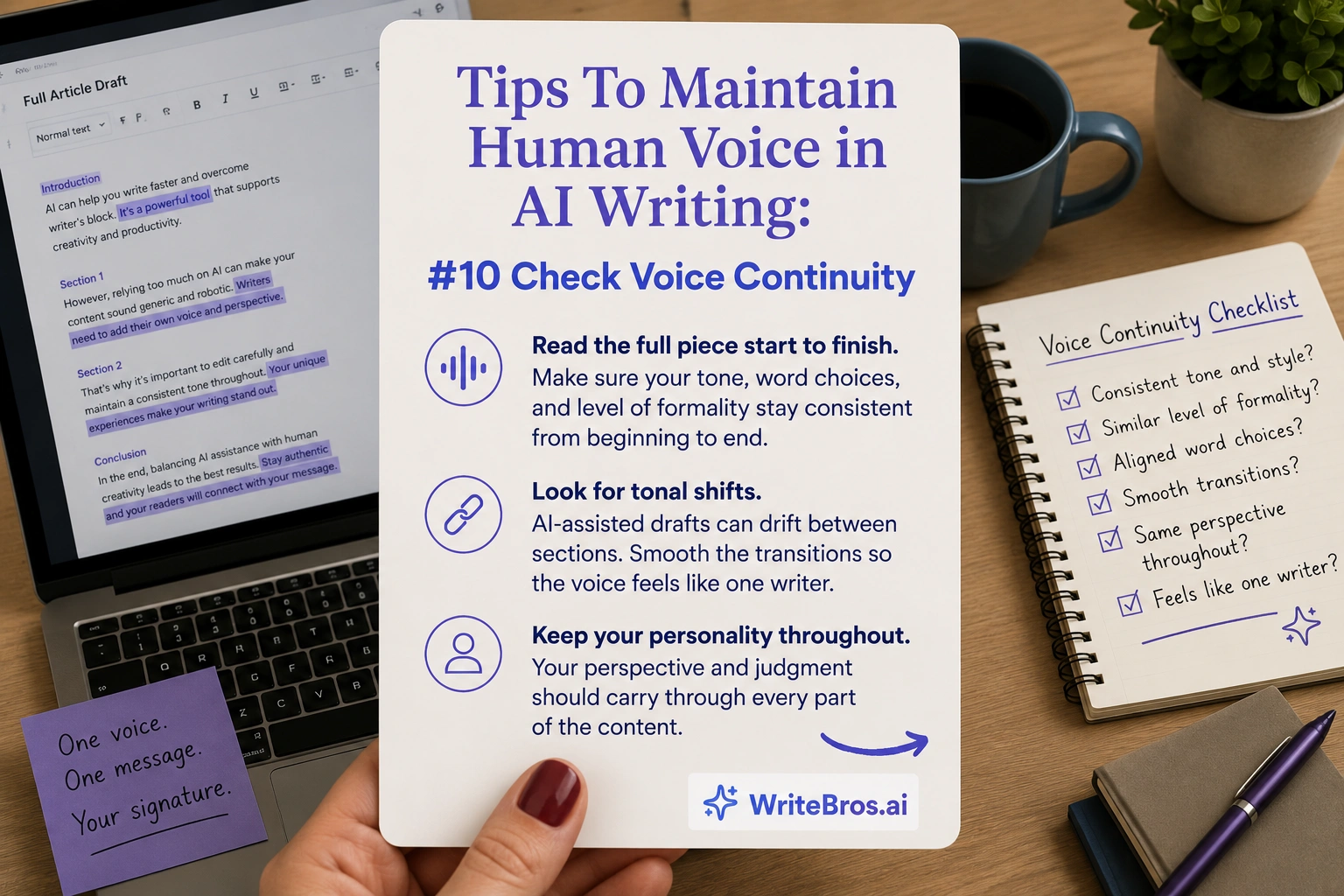
How to Maintain Human Voice in AI-Assisted Writing – Strategy #10: Check Voice Continuity
Read the article from beginning to end without editing individual sentences, focusing instead on whether the same recognizable personality carries across introductions, explanations, examples, transitions, and conclusions. AI-assisted drafts often shift subtly because different sections were generated through separate prompts, revised at different times, or expanded using inconsistent instructions. Good continuity means the level of confidence, warmth, detail, and formality changes only when the subject requires it rather than because the drafting process created accidental variation.
This review works because voice is experienced across the entire piece, not proven by a few strong paragraphs that happen to sound personal. A guide may open with direct, grounded language but become increasingly corporate in later sections, especially when supporting points were generated separately and inserted without a full read. The constraint is that consistency should not become monotony, since examples, warnings, explanations, and conclusions naturally need different levels of energy while still belonging to the same writer.
How to Maintain Human Voice in AI-Assisted Writing – Strategy #11: Question Every Suggestion
Treat every AI-generated revision as a proposal that must earn its place rather than an improvement that should be accepted automatically. Many suggestions make sentences smoother, more concise, or more conventionally professional, yet those same changes can remove hesitation, emphasis, humor, or unusual phrasing that reflects how you actually think. Careful evaluation means asking what the revision improves, what it removes, and whether the tradeoff serves the reader and the purpose of the piece.
This safeguard works because AI editing tools are usually optimized for broad readability patterns rather than the specific identity you are trying to preserve. A suggestion might replace a precise but uncommon phrase with a familiar alternative, improving immediate simplicity while weakening the originality of the observation. The caveat is that rejecting suggestions merely because they came from AI can preserve genuine weaknesses, so each decision should be based on function rather than defensiveness.
How to Maintain Human Voice in AI-Assisted Writing – Strategy #12: Adapt Without Disappearing
Adjust your voice for the audience, platform, and subject while keeping the underlying habits that make your writing recognizably yours. Audience awareness may require simpler vocabulary, more explanation, greater formality, or a different level of emotional distance, but adaptation should not reduce the writing to a generic version of what you assume readers expect. Strong execution preserves your characteristic reasoning, examples, and emphasis even when the surface style changes to suit the context.
This works because authentic voice is not a fixed collection of phrases but a consistent way of noticing, organizing, and explaining ideas. A technical audience may need precise terminology, while a general audience needs clearer framing, yet both versions can reflect the same preference for practical examples and honest limitations. The risk is overcorrecting toward imagined expectations, especially when audience assumptions are based on stereotypes rather than evidence from actual readers, clients, or performance data.
How to Maintain Human Voice in AI-Assisted Writing – Strategy #13: Preserve Useful Imperfection
Resist the urge to polish every sentence into perfect symmetry, complete neutrality, or maximum efficiency when a small irregularity makes the writing feel more natural and expressive. Human voice often appears through slightly uneven pacing, selective repetition, qualified statements, and moments where the writer chooses clarity or emphasis over elegance. Good judgment means preserving imperfections that serve meaning while correcting those that create confusion, distract the reader, or weaken credibility.
This approach works because overly optimized prose can feel detached from the mind behind it, particularly when every sentence follows the same polished rhythm and every transition announces itself neatly. A repeated phrase may be worth keeping when it reinforces an important distinction, even though a style tool flags it as redundant. The limitation is that authenticity should never become an excuse for careless grammar, vague logic, or avoidable errors that force readers to work harder than necessary.
How to Maintain Human Voice in AI-Assisted Writing – Strategy #14: Build a Checklist
Create a repeatable review checklist based on the voice problems that appear most often in your AI-assisted drafts, then apply it before publishing or submitting important work. The checklist might cover generic transitions, unsupported certainty, repetitive sentence structures, missing examples, emotional flattening, and conclusions that sound interchangeable. A useful checklist remains short enough to use consistently while being specific enough to direct attention toward patterns that ordinary proofreading rarely catches.
This works because repeated mistakes are easier to manage when they are turned into visible review prompts rather than left to memory. If your drafts regularly become more formal in later sections, the checklist can require a full voice-continuity read before final approval. The main constraint is that the checklist should evolve, since outdated rules can make editing rigid, and new tools, formats, audiences, or writing habits may introduce different weaknesses over time.
How to Maintain Human Voice in AI-Assisted Writing – Strategy #15: Review Your Patterns
Compare several finished pieces periodically to identify which parts consistently sound like you and which passages repeatedly drift toward generic AI language. Looking across multiple drafts reveals habits that are difficult to notice within a single article, including preferred openings, repeated transitions, overused prompts, and moments where your strongest perspective tends to disappear. Effective review involves saving representative samples, noting recurring strengths and weaknesses, and updating your instructions based on what the evidence shows.
This works because voice becomes easier to preserve when it is treated as an observable pattern rather than an instinct that appears automatically. You may discover that your examples remain distinctive while your introductions sound increasingly standardized, suggesting that the drafting prompt rather than the entire workflow needs adjustment. The limitation is that analysis should support writing rather than make it self-conscious, so use pattern reviews occasionally and avoid monitoring every sentence so closely that the work loses spontaneity.
Common mistakes
- Giving the AI vague instructions such as make this sound human or improve the tone usually produces broadly polished language because the system has no concrete evidence of what your voice sounds like, and the result often becomes smoother while losing the specific choices that made the original draft recognizable.
- Accepting every grammatical or stylistic recommendation can gradually flatten personality because many editing tools favor conventional clarity, balanced structure, and neutral professionalism, which are useful standards in moderation but can remove intentional repetition, emotional texture, unusual phrasing, and the subtle emphasis that distinguishes one writer from another.
- Generating each section separately without conducting a complete voice review often creates tonal drift because different prompts, revisions, and source materials influence the language in inconsistent ways, leaving the introduction conversational, the middle overly formal, and the conclusion generic even though each section appears acceptable when reviewed alone.
- Trying to sound more personal by adding slang, fragments, jokes, or casual expressions usually backfires when those elements do not reflect the writer’s actual habits, because manufactured informality is still a form of imitation and may feel less authentic than a restrained, professional style that genuinely matches the person behind it.
- Removing all imperfections in pursuit of maximum polish can make a draft feel synthetic because natural writing contains variation, selective repetition, changing sentence lengths, and occasional asymmetry, while prose that has been optimized into identical levels of smoothness often sounds detached from the thinking and judgment that produced it.
- Focusing only on word choice while ignoring argument, examples, and emphasis weakens voice because authenticity is carried through what the writer notices and prioritizes, not merely through favorite expressions, and a draft can use familiar vocabulary while still feeling personal if its reasoning reflects a distinct and credible perspective.
Edge cases
Some forms of writing require tighter control over voice because consistency, compliance, or accuracy matters more than individual expression. Legal notices, medical explanations, technical procedures, and regulated communications may need standardized language, yet the writer can still preserve clarity through thoughtful organization, precise examples, and an appropriate level of empathy without introducing unnecessary personality.
Collaborative writing also complicates authorship because the final voice may belong to a team, brand, or publication rather than one person. In those cases, authenticity means maintaining an agreed editorial identity across contributors, documenting shared standards, and allowing limited variation where it helps different subjects feel natural without making the overall body of work sound inconsistent.
Supporting tools
- A personal voice guide can document preferred tone, sentence patterns, vocabulary, examples, prohibited phrases, and common editing decisions, giving writers and AI systems a practical reference that is more useful than broad instructions to sound natural, friendly, polished, or professional.
- A text-to-speech reader can reveal awkward cadence, repetitive structures, and overly formal transitions by letting you hear the draft without relying on your own visual familiarity, which is particularly useful after several editing passes have made obvious weaknesses harder to notice.
- A version comparison tool helps you examine what changed between the original draft and the AI-assisted revision, making it easier to identify moments where clarity improved but personality disappeared, or where a polished replacement removed useful detail, hesitation, emphasis, or emotional nuance.
- A style checklist gives each review pass a consistent purpose by prompting you to examine sentence rhythm, generic phrasing, real examples, tonal continuity, unsupported certainty, and conclusion quality before the draft moves into final proofreading or publication.
- A searchable archive of previous work provides concrete samples of how you naturally explain, persuade, qualify, and transition between ideas, allowing you to compare new drafts against real evidence rather than relying on an abstract memory of what your voice should sound like.
- WriteBros.ai can support the refinement process by helping writers revise AI-generated content around selected stylistic preferences, although the final review should still involve human judgment, contextual awareness, and direct comparison with examples of the writer’s established work.
Ready to Transform Your AI Content?
Try WriteBros.ai and make your AI-generated content truly human.
Conclusion
Maintaining a human voice in AI-assisted writing is less about disguising the use of technology and more about protecting the judgment, rhythm, detail, and emotional awareness that make the work recognizably yours. Clear intentions, real examples, selective editing, and consistent review help ensure that efficiency does not replace perspective or reduce every draft to the same polished pattern.
The process does not require every sentence to sound unusual, personal, or perfectly distinctive, because clarity and familiarity still matter to readers. What matters is making deliberate choices, questioning automatic revisions, and preserving the parts of your writing that carry genuine thought, so the finished piece feels guided by a person rather than merely processed by a system.
Did You Know?
AI can improve the perceived quality of an individual piece of writing while quietly pulling different writers toward more similar ideas, language patterns, and creative choices.
A peer-reviewed study published in Science Advances found that AI-assisted stories were evaluated as more creative, better written, and more enjoyable, especially among less creative writers, yet they were also more similar to one another than stories written without AI assistance. Maintaining an authentic voice therefore requires writers to preserve their own perspective, examples, rhythm, emotional nuance, and editorial judgment throughout the drafting process.
Ready to Transform Your AI Content?