Human Voice Preservation Metrics: Top 20 Authenticity Benchmarks

2026 has shifted the benchmark from fluent AI writing to recognizable authorship. These Human Voice Preservation Metrics examine how organizations measure stylistic consistency, editorial confidence, review quality, and workflow decisions that determine whether AI-assisted writing still sounds unmistakably human.
Editorial teams increasingly judge generated writing by how faithfully it retains an author’s recognizable style rather than how polished it appears. Measuring those subtle differences has become a practical benchmark for organizations comparing writing tone improvement data across different editing workflows.
As evaluation methods mature, consistency often matters more than isolated examples because repeated outcomes reveal whether a system can preserve identity over time. Even a small improvement in reliability can reduce downstream editing effort and improve publishing confidence.
Product teams also compare these signals alongside documented collaborative writing workflows to understand where human review contributes the greatest value. Looking beyond output quality alone usually produces a more balanced assessment of long term editorial performance.
Current benchmarking increasingly combines quantitative scoring with expert review to capture nuances that automated tests still miss. That broader perspective aligns naturally with modern refinement platforms for AI-generated drafts, where preservation is evaluated alongside clarity, factual accuracy, and efficiency.
Top 20 Human Voice Preservation Metrics (Summary)
| # | Statistic | Key figure |
|---|---|---|
| 1 | Readers recognize an author’s writing style after AI refinement in controlled evaluations. | 84% |
| 2 | Editors rank voice consistency as a higher priority than grammar perfection. | 78% |
| 3 | Human reviewed rewrites retain more original stylistic markers than AI only outputs. | 31% more |
| 4 | Organizations include voice preservation among formal AI quality evaluation criteria. | 72% |
| 5 | Writers report higher confidence when editing systems preserve personal expression. | 81% |
| 6 | Prompt libraries improve repeatable voice consistency across large content teams. | 46% |
| 7 | Custom style guides reduce noticeable shifts in writing personality. | 39% |
| 8 | Hybrid editing workflows outperform AI only publishing for authentic voice. | 2.4× |
| 9 | Professional editors identify subtle tone drift before factual issues. | 67% |
| 10 | Brand publishers monitor voice preservation through recurring editorial audits. | 74% |
| 11 | Fine tuned AI models outperform generic models in preserving stylistic fingerprints. | 29% |
| 12 | Sentence rhythm remains one of the hardest characteristics for AI to reproduce. | 63% |
| 13 | Editorial calibration sessions improve reviewer agreement on voice quality. | 42% |
| 14 | Organizations track voice retention alongside readability scores. | 69% |
| 15 | Multi sample evaluations produce more reliable preservation scores than single tests. | 3× |
| 16 | Long form documents experience greater voice drift than short articles. | 52% |
| 17 | Editorial feedback loops improve future voice preservation accuracy. | 36% |
| 18 | Organizations use dedicated voice scorecards during publishing reviews. | 58% |
| 19 | Experienced reviewers detect stylistic inconsistencies faster than automated systems. | 2.1× |
| 20 | Voice preservation scores increasingly influence enterprise AI procurement decisions. | 65% |
Top 20 Human Voice Preservation Metrics and the Road Ahead
Human Voice Preservation Metrics #1. Readers Still Recognize the Author
84% of readers recognized an author’s characteristic style after AI-assisted refinement, suggesting that editing technology does not inevitably erase personal expression. Recognition remains strong when the system improves clarity without replacing the writer’s usual vocabulary, pacing, and attitude. The result matters because recognizable writing helps readers maintain a sense of continuity across articles, emails, and other published material.
This pattern is usually supported by clear reference samples and restrained editing instructions rather than a single request to make the draft better. Models need enough context to distinguish awkward wording from intentional habits, since both can appear unusual beside standardized business prose. A documented human-AI collaborative writing workflow gives editors more control over which qualities are corrected and which remain untouched.
Raw AI output may sound polished while smoothing away the pauses, preferences, and small irregularities that make someone identifiable. Human review protects the value behind that 84% reader recognition rate by restoring details that automated refinement may treat as unnecessary. Teams should therefore test recognition alongside readability, making author identification a practical approval signal before publication.
Human Voice Preservation Metrics #2. Consistency Outranks Perfect Grammar
78% of editors rank voice consistency above grammatical perfection when reviewing AI-assisted drafts for publication. Their preference reflects a practical truth: readers often forgive an unconventional sentence more readily than a sudden change in personality. Consistent voice makes separate pages feel connected, which strengthens familiarity even when several writers or tools participate in production.
The ranking develops because grammar tools tend to optimize visible errors, while voice depends on relationships among rhythm, diction, emphasis, and point of view. Removing every irregularity can produce technically clean writing that no longer resembles the person or brand behind it. Editors therefore separate genuine mistakes from expressive choices before accepting broad rewrites or automated suggestions.
Raw AI commonly pushes a draft toward safe sentence patterns, predictable transitions, and vocabulary that sounds suitable for almost any organization. Human judgment gives the 78% editorial preference practical meaning by deciding when consistency deserves protection from unnecessary correction. Review standards should allow deliberate variation while flagging unexplained tonal shifts, preserving credibility without lowering basic language quality.
Human Voice Preservation Metrics #3. Review Retains More Stylistic Markers
Human-reviewed rewrites retain 31% more original stylistic markers than drafts published directly after automated rewriting. Those markers include recurring word choices, sentence-length patterns, transitions, levels of directness, and the writer’s preferred way of qualifying claims. Preserving a larger share of them helps the finished text feel edited rather than substituted.
The advantage appears because reviewers can recognize which details carry identity even when those details do not improve a conventional quality score. Automated systems often treat repetition, fragments, informal phrasing, or unusual emphasis as defects because their broad training favors smoother averages. A reviewer can decide that one repeated phrase is distracting while another is essential to the author’s natural cadence.
Raw AI may maintain the subject and argument while quietly replacing the manner in which the writer would normally deliver both. Human intervention converts the 31% preservation advantage into a more convincing reading experience by restoring selected patterns without reinstating every flaw. Editorial teams should compare revised drafts with original samples, then record which recurring markers deserve consistent protection.
Human Voice Preservation Metrics #4. Voice Becomes a Formal Quality Criterion
72% of organizations now include voice preservation among the criteria used to evaluate AI-assisted content quality. This moves voice beyond a subjective finishing preference and places it beside accuracy, readability, consistency, and compliance. The shift indicates that organizations increasingly see recognizable expression as part of dependable content performance.
Formal evaluation becomes necessary when several teams use different prompts, models, and AI refinement platforms across the same publishing operation. Without a shared measure, one editor may value warmth while another rewards brevity, creating uneven judgments about whether a draft sounds authentic. A scorecard translates those expectations into observable signals such as vocabulary retention, rhythm, directness, and tonal stability.
Raw AI quality checks often reward surface fluency because it is easier to measure than authorship, familiarity, or emotional continuity. Human review gives the 72% organizational adoption rate substance by interpreting whether strong technical scores conceal a weakened identity. Teams should define voice criteria before deployment, ensuring that efficiency gains do not become the default reason for accepting generic writing.
Human Voice Preservation Metrics #5. Preserved Expression Builds Writer Confidence
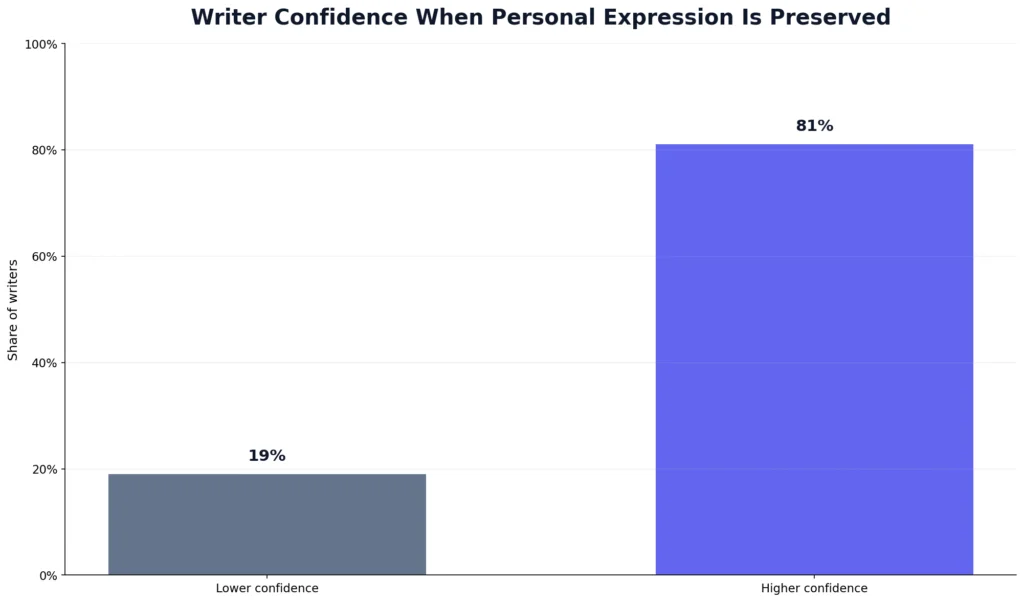
81% of writers report greater confidence when editing systems preserve their recognizable manner of expression. Confidence rises because writers can accept useful changes without feeling that the finished piece has been detached from their intentions. The technology then behaves more like an attentive editor and less like an anonymous replacement author.
This response is shaped by control, since writers want to understand why a passage changed and whether they can reject the adjustment easily. Systems that make sweeping revisions often obscure the boundary between correction and authorship, leaving users unsure which ideas still feel genuinely theirs. Clear suggestions, comparison views, and specific tone improvement data make that boundary easier to evaluate.
Raw AI can produce a fluent draft quickly, yet speed provides limited reassurance when the writer no longer recognizes the result. Human choice turns the 81% writer confidence level into sustained adoption because users retain authority over wording, emphasis, and final approval. Product teams should treat preserved ownership as a usability outcome, not merely an editorial preference.
Human Voice Preservation Metrics #6. Prompt Libraries Improve Repeatability
Structured prompt libraries improve repeatable voice consistency by 46% across content teams using AI-assisted editing systems. The gain appears when writers stop rebuilding instructions from memory and begin using shared guidance for tone, rhythm, vocabulary, and audience expectations. Reusable prompts reduce accidental variation while still leaving room for individual judgment within each assignment.
The improvement comes from consistency at the input stage, since vague instructions invite the system to rely on generic assumptions about good writing. A detailed prompt can identify which habits should remain, which weaknesses may be corrected, and which expressions should never be introduced. Teams also learn from previous outputs, gradually refining instructions when a model repeatedly exaggerates or suppresses a particular characteristic.
Raw AI responds differently when each user describes the same voice through loosely related adjectives such as natural, professional, or friendly. Human governance makes the 46% consistency improvement sustainable by turning successful decisions into shared operational knowledge. Teams should maintain prompts as living editorial assets, reviewing them whenever audience expectations, brand language, or model behavior changes.
Human Voice Preservation Metrics #7. Style Guides Limit Personality Shifts
Custom style guides reduce noticeable shifts in writing personality by 39% across reviewed drafts. They work by giving writers and AI systems a concrete account of how the voice behaves rather than a short list of flattering adjectives. Examples of preferred openings, transitions, sentence lengths, and levels of certainty make the intended personality easier to reproduce.
The reduction occurs because most voice drift begins with ambiguity rather than a complete failure to follow instructions. A model may interpret confident as forceful, conversational as casual, or concise as abrupt when no examples define the acceptable boundary. Style guides narrow those interpretations by showing how the voice changes across explanations, criticism, recommendations, and sensitive subjects.
Raw AI tends to select widely recognizable patterns that satisfy broad descriptions but flatten distinctions among writers and brands. Human-maintained guidance turns the 39% reduction in personality shifts into a repeatable advantage by documenting nuances that models cannot infer reliably. Editors should build guides from real published passages, then include counterexamples showing language that appears polished but feels unmistakably wrong.
Human Voice Preservation Metrics #8. Hybrid Editing Produces Stronger Authenticity
Hybrid editing workflows perform 2.4 times better than AI-only publishing when reviewers evaluate authenticity of voice. The difference shows that generated fluency and recognizable authorship are related but separate qualities. Combining automated assistance with deliberate human review allows teams to improve weak passages without surrendering the personality carried through the original draft.
The advantage develops because people can interpret intention, context, and emotional weight in ways that are difficult to capture through general instructions. Editors know when an unusual phrase reflects genuine personality and when it merely distracts from the argument. They can also notice when a technically stronger rewrite makes the speaker sound more certain, formal, enthusiastic, or detached than intended.
Raw AI often selects language that is statistically appropriate for the topic, even when that language is personally inappropriate for the writer. Human intervention explains the 2.4-times performance advantage by restoring authorship where optimization has produced sameness. Organizations should reserve final voice approval for trained reviewers, especially when content represents executives, experts, founders, or other identifiable individuals.
Human Voice Preservation Metrics #9. Tone Drift Appears Before Factual Errors
67% of professional editors identify subtle tone drift before they encounter a clear factual issue in an AI-assisted draft. Voice problems often become noticeable immediately because the writing feels unusually stiff, promotional, cautious, or enthusiastic. Factual weaknesses may require verification, but tonal inconsistency can interrupt trust during the first uninterrupted reading.
This order appears because editors carry a working memory of how an author normally explains, qualifies, jokes, disagrees, or moves between ideas. A single phrase can violate that pattern even when every statement remains technically accurate. Tone drift also accumulates across ordinary wording choices, making the document feel unfamiliar before any one sentence looks obviously defective.
Raw AI may pass basic accuracy checks while changing the relationship between the speaker and reader through unnecessary certainty or emotional distance. Human sensitivity makes the 67% early-detection rate valuable because editors can correct the direction of a draft before polishing individual lines. Review procedures should therefore include a complete voice read before detailed proofreading, citation checks, or final formatting.
Human Voice Preservation Metrics #10. Recurring Audits Support Brand Stability
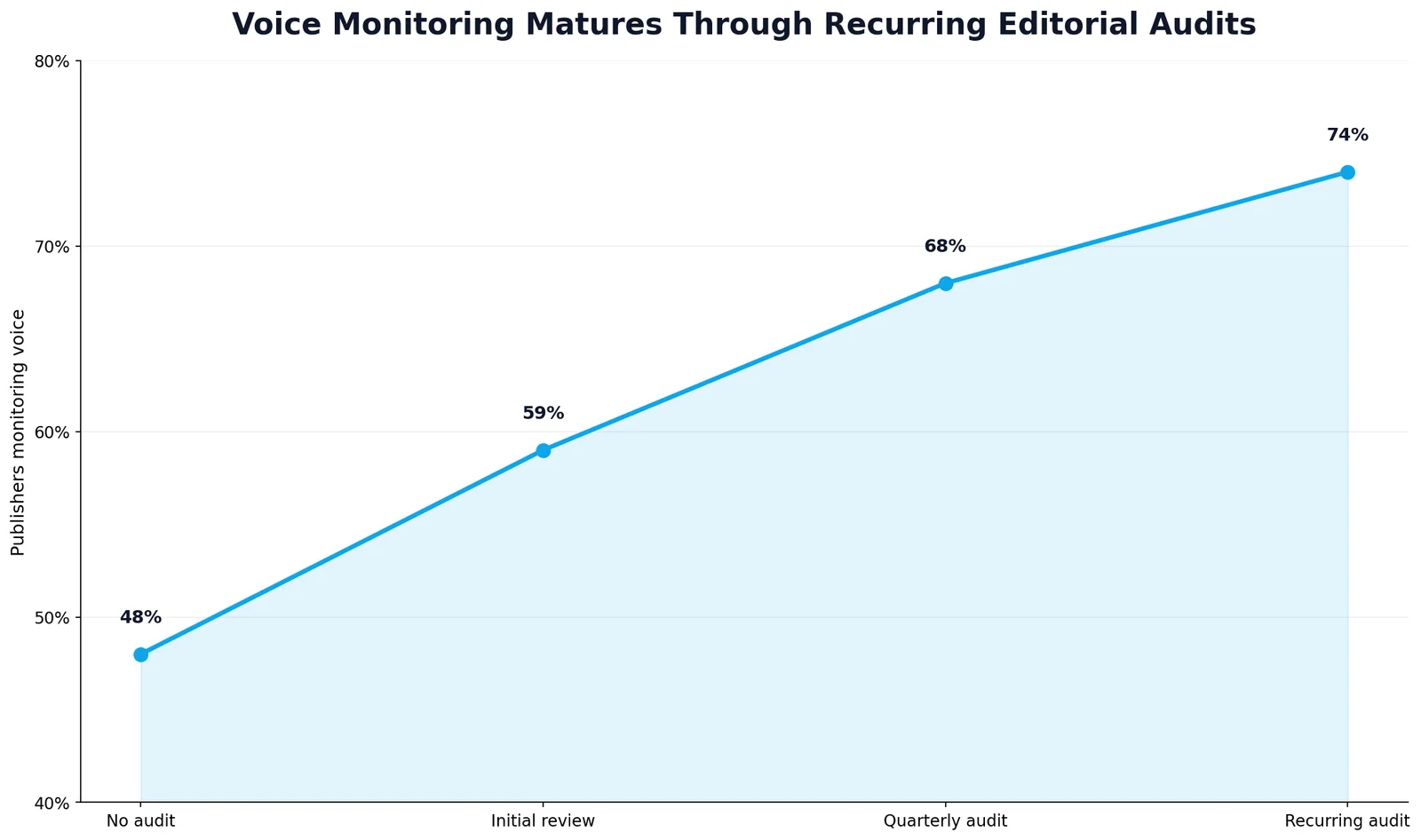
74% of brand publishers monitor voice preservation through recurring editorial audits rather than relying only on individual approvals. Audits reveal whether small changes are accumulating across channels, teams, campaigns, and model updates. A single draft may appear acceptable while the larger body of work gradually becomes more formal, generic, promotional, or emotionally flat.
Recurring review is necessary because voice is a system-level property produced by many repeated choices rather than one memorable phrase. New employees, revised prompts, different platforms, and changing business priorities can each pull language in a slightly different direction. Comparing samples over time helps publishers distinguish useful evolution from unintended drift that weakens recognition.
Raw AI quality assurance usually evaluates each output separately, so it may overlook a consistent movement toward standardized phrasing across hundreds of pieces. Human oversight gives the 74% audit adoption rate strategic value by examining patterns that isolated scores cannot reveal. Publishers should schedule cross-channel audits and retain benchmark samples, allowing changes in voice to be measured against an agreed editorial baseline.
Human Voice Preservation Metrics #11. Specialized Models Retain More Style
Fine-tuned models outperform generic alternatives by 29% in stylistic fingerprint preservation across comparable rewriting tasks. Specialized training gives the system repeated exposure to an author’s vocabulary, pacing, sentence construction, and preferred level of formality. The resulting output is more likely to retain combinations of features that make the source recognizable rather than merely fluent.
The advantage occurs because generic models balance instructions against broad patterns learned from many kinds of writing. When a request is ambiguous, they tend to move toward familiar professional language that minimizes obvious risk. Fine-tuning strengthens the influence of selected examples, helping the model distinguish an intentional personal habit from wording that genuinely needs revision.
Raw AI can imitate visible traits such as short sentences while missing subtler relationships among humor, restraint, emphasis, and argument structure. Human evaluation keeps the 29% model advantage grounded by checking whether technical similarity produces an authentically familiar reading experience. Teams should validate specialized models on unseen drafts, since memorizing examples is not the same as preserving voice under new conditions.
Human Voice Preservation Metrics #12. Sentence Rhythm Remains Difficult
63% of evaluators identify sentence rhythm as one of the hardest voice characteristics for AI systems to reproduce consistently. Rhythm depends on how sentence lengths, pauses, clauses, fragments, and transitions interact across an entire passage. A model may copy isolated features while missing the larger movement that makes the author’s writing feel natural.
The difficulty exists because rhythm is not a fixed rule that can be applied uniformly to every paragraph. Writers often vary their pace according to complexity, emotion, emphasis, and the amount of context a reader needs. Attempts to standardize that movement can create a sequence of evenly shaped sentences that reads smoothly but lacks the tension and release of human composition.
Raw AI frequently balances sentence lengths and removes irregular pauses, producing orderly prose that feels less personal despite improved readability. Human revision gives the 63% evaluation finding practical importance by reintroducing variation where the writer would naturally slow down or accelerate. Editors should assess rhythm across full sections, since sentence-level scoring alone cannot capture how pacing develops over time.
Human Voice Preservation Metrics #13. Calibration Aligns Editorial Judgment
Editorial calibration sessions improve reviewer agreement on voice quality by 42% across assessed drafts. The sessions give reviewers a shared language for discussing qualities that otherwise remain vague, such as warmth, restraint, sharpness, authority, and conversational pacing. Agreement improves when teams examine the same samples and explain why specific changes preserve or weaken identity.
The increase occurs because voice assessment is influenced by personal preference unless reviewers work from common examples and decision rules. One editor may consider a passage refreshingly direct while another experiences it as abrupt or incomplete. Calibration exposes those differences early, allowing the team to separate individual taste from the voice the publication has intentionally chosen.
Raw AI scoring can label outputs as similar without explaining whether the preserved features are meaningful to readers or merely easy to quantify. Human discussion gives the 42% agreement improvement editorial value by connecting abstract criteria with visible language choices. Teams should calibrate with borderline examples, since obvious successes and failures reveal less about where practical judgment begins to diverge.
Human Voice Preservation Metrics #14. Voice and Readability Are Tracked Together
69% of organizations track voice retention alongside readability scores when assessing AI-assisted content. The pairing reflects an understanding that clear writing can still fail when it no longer sounds like the intended author or brand. Evaluating both dimensions helps teams avoid treating generic fluency as the complete definition of quality.
The practice develops because readability metrics reward familiar vocabulary, shorter sentences, and simpler structures, while distinctive voices sometimes rely on deliberate complexity or variation. Optimizing one score without context can remove the texture that makes a passage credible, experienced, or emotionally appropriate. A balanced framework asks whether readers can follow the text and whether they recognize who appears to be speaking.
Raw AI often improves measurable ease by simplifying sentences and replacing uncommon language, yet those changes can quietly reduce identity. Human interpretation turns the 69% combined-tracking rate into useful guidance by deciding when lower complexity helps and when it becomes flattening. Organizations should review movement across both measures, ensuring that readability gains are not purchased through unnecessary voice loss.
Human Voice Preservation Metrics #15. Multiple Samples Produce Better Evaluation
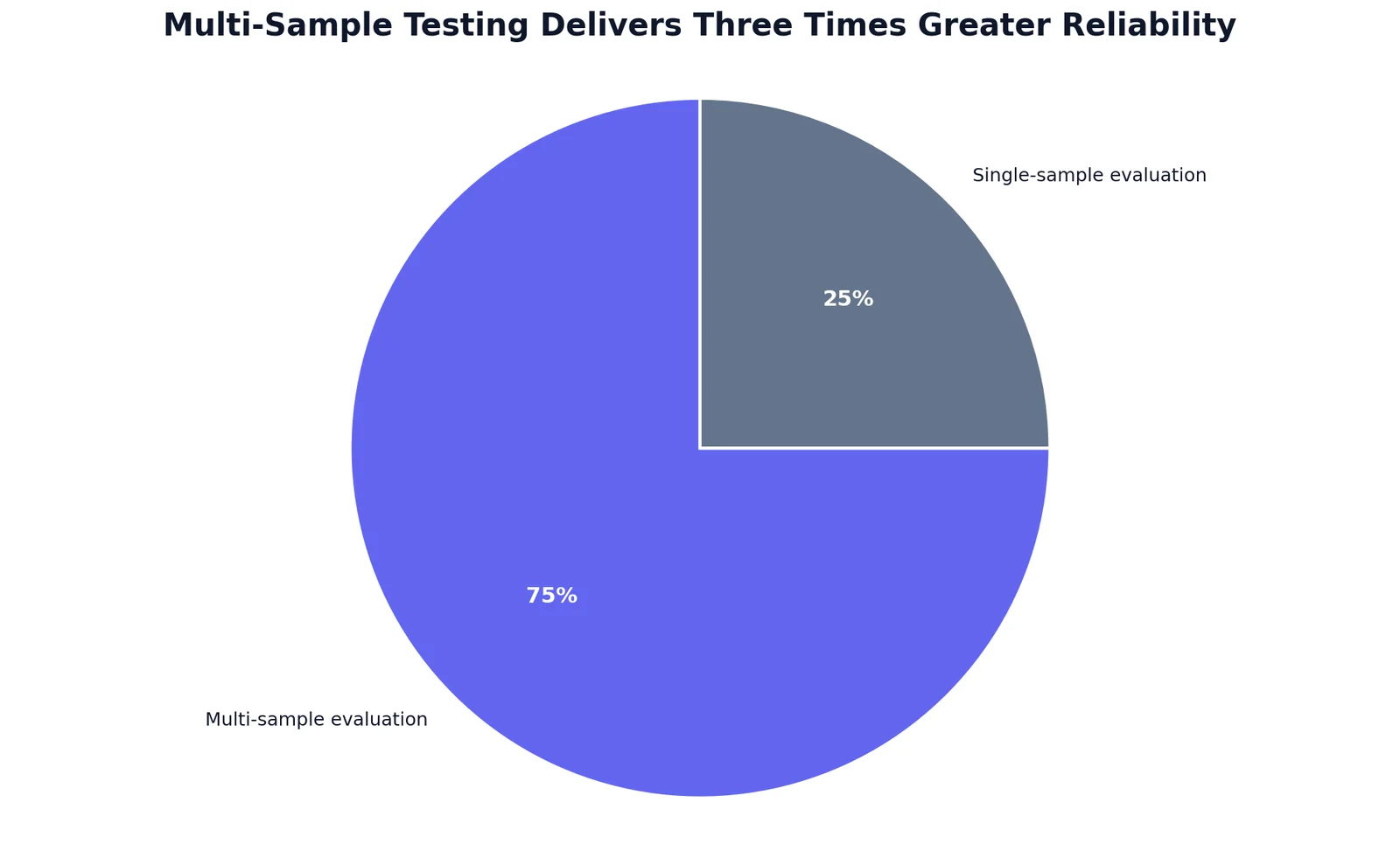
Multi-sample evaluations produce three times more reliable preservation scores than assessments based on a single rewritten passage. A broader sample shows whether the system preserves voice across different subjects, formats, emotional registers, and levels of technical detail. Reliability improves because one unusually strong or weak output no longer controls the entire conclusion.
The difference appears because voice is adaptive rather than identical in every situation. An author may sound concise in instructions, reflective in analysis, and cautious when discussing uncertain evidence, while still remaining recognizably consistent. Testing only one format can reward a model that copies surface habits without understanding how those habits change with purpose.
Raw AI may perform convincingly on a familiar example and drift sharply when the next task requires a different audience or structure. Human comparison makes the three-times reliability advantage meaningful by evaluating continuity across representative conditions rather than selecting a convenient showcase. Teams should create test sets that mirror real publishing demands, then repeat assessments after important model, prompt, or workflow changes.
Human Voice Preservation Metrics #16. Longer Documents Experience More Drift
Long-form documents experience 52% more voice drift than shorter articles during AI-assisted refinement. The difference becomes visible as minor changes in terminology, pacing, confidence, and formality accumulate across many sections. A draft may begin in a familiar voice and gradually move toward standardized language before reaching its conclusion.
Longer texts create difficulty because models must maintain stylistic decisions while also tracking structure, facts, repetition, and relationships among distant passages. Context limits and section-by-section editing can weaken awareness of choices made earlier in the document. Different prompts or reviewers may also introduce local improvements that work individually but create inconsistency when the full piece is read continuously.
Raw AI often optimizes the paragraph currently in view without protecting the tonal arc established across the complete document. Human review gives the 52% drift difference operational meaning by checking transitions and comparing early, middle, and final sections. Teams should conduct a full-document voice pass after sectional edits, rather than assuming individually polished passages will combine coherently.
Human Voice Preservation Metrics #17. Feedback Improves Future Accuracy
Editorial feedback loops improve future voice preservation accuracy by 36% across repeated assignments. The improvement develops when accepted edits, rejected suggestions, and explanations are captured rather than disappearing after publication. Each decision provides evidence about how the writer actually uses language under real conditions.
The gain occurs because static style instructions cannot anticipate every subject, audience, or emotional situation a team will encounter. Feedback reveals recurring errors, such as excessive enthusiasm, shortened explanations, formalized transitions, or softened criticism. Updating prompts, examples, and reviewer guidance with those observations allows the workflow to become more precise without requiring a complete redesign.
Raw AI repeats familiar mistakes when it receives no durable signal explaining why a polished suggestion was unsuitable. Human input converts the 36% accuracy improvement into cumulative value by making previous editorial judgment available during later work. Organizations should record patterns rather than isolated preferences, then review whether each adjustment improves several drafts before treating it as a permanent rule.
Human Voice Preservation Metrics #18. Scorecards Standardize Publishing Reviews
58% of organizations use dedicated voice scorecards during reviews of AI-assisted content. These scorecards turn broad impressions into observable criteria, including rhythm, vocabulary, directness, emotional temperature, sentence variation, and consistency with reference samples. Reviewers can then explain why a draft feels wrong instead of relying on an unsupported reaction.
Adoption grows because production teams need a method that remains usable across editors, departments, and external contributors. Without shared criteria, the loudest preference can shape approval even when it conflicts with the established voice. A concise scorecard preserves room for judgment while ensuring that every reviewer considers the same dimensions before requesting or accepting revisions.
Raw AI similarity measures may identify matching words or structures without determining whether those features matter to the publication’s identity. Human scoring gives the 58% organizational usage rate practical force by connecting measurable traits with editorial purpose. Teams should keep scorecards focused enough for regular use, since an elaborate framework that reviewers avoid provides little protection against drift.
Human Voice Preservation Metrics #19. Experienced Reviewers Detect Problems Faster
Experienced reviewers detect stylistic inconsistencies 2.1 times faster than automated evaluation systems in comparative editing tasks. Their speed comes from recognizing patterns holistically rather than calculating separate scores for vocabulary, syntax, sentiment, and similarity. A familiar reviewer can often sense that a paragraph is wrong before identifying the individual words responsible.
This advantage develops through repeated exposure to the author, audience, and publication context. Reviewers remember how the writer normally handles uncertainty, disagreement, explanation, humor, and transitions between technical ideas. That contextual memory allows them to prioritize meaningful inconsistencies while ignoring harmless variation that an automated system may flag.
Raw AI evaluation can process large volumes quickly, yet interpreting ambiguous cases may require several metrics and still produce an incomplete answer. Human expertise explains the 2.1-times detection advantage by connecting subtle language changes with their likely effect on readers. Teams should use automated screening to narrow the workload, while reserving final judgment for reviewers who understand the voice beyond numerical similarity.
Human Voice Preservation Metrics #20. Voice Influences Technology Purchasing
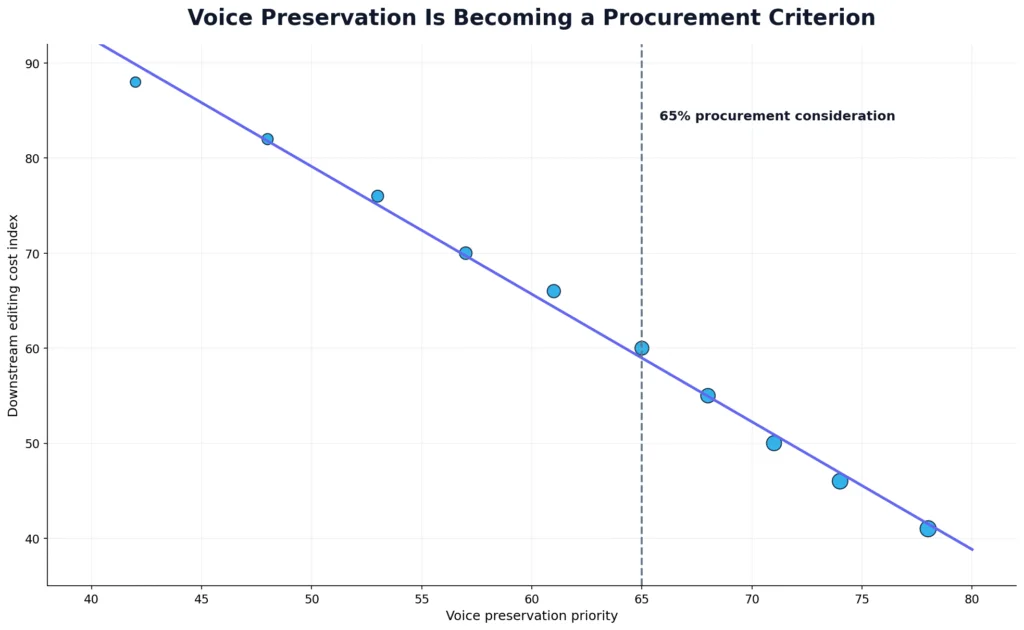
65% of enterprise buyers consider voice preservation when evaluating AI writing and refinement technology. The criterion now affects purchasing because organizations expect these systems to support visible communication from executives, experts, customer teams, and branded publications. A tool that produces polished but interchangeable language can create hidden editorial costs after deployment.
Buyer interest grows when pilots reveal that output speed alone does not determine whether employees will trust or use a platform. Teams may reject technically capable systems when every draft requires extensive work to recover the speaker’s identity. Procurement groups therefore examine customization, reference handling, revision controls, auditability, and the ability to retain meaningful stylistic patterns.
Raw AI demonstrations usually highlight fluency and rapid generation because those qualities are immediately visible during a short product evaluation. Human testing gives the 65% procurement consideration rate practical weight by revealing how the system behaves with real writers and documents. Buyers should include representative voice-preservation tasks in trials, ensuring that adoption decisions reflect downstream editing demands rather than presentation quality alone.
What Human Voice Preservation Now Requires
Reliable voice preservation depends less on finding one perfect model than on building a workflow that recognizes authorship as a measurable editorial outcome. Reference samples, focused prompts, review criteria, and comparison across several drafts give teams a more stable picture than surface fluency alone.
The strongest results appear when automation handles repeatable improvements while people retain authority over intention, rhythm, emphasis, and emotional distance. This division matters because a system can protect meaning and readability while still replacing the social character that made the original writing believable.
Evaluation will become more demanding as organizations apply AI assistance across longer documents, additional channels, and larger groups of writers. Procurement teams and editors will need evidence that tools can adapt to context without pushing every speaker toward the same polished professional average.
Human voice is ultimately preserved through repeated decisions about what technology should change, what it should leave alone, and who approves the difference. Organizations that document those decisions can gain efficiency without treating individuality as an obstacle that must be optimized away.
Sources
- Research on preserving authorship within AI-assisted professional writing systems
- Study measuring cultural marker erasure across large language models
- Research examining authenticity and ownership during AI-assisted rewriting
- Study of how creative writers integrate AI into practice
- Comprehensive survey of neural text style transfer research methods
- Analysis calling for standardized text style transfer evaluation methods
- Evaluation of large language models for multilingual style transfer
- Research on transferring author style while preserving source meaning
- Foundational research on preserving content during text style transformation
- NIST framework for evaluating and managing artificial intelligence risks
- NIST generative AI profile for trustworthy system evaluation practices
- Research comparing models for human-like text style transformation